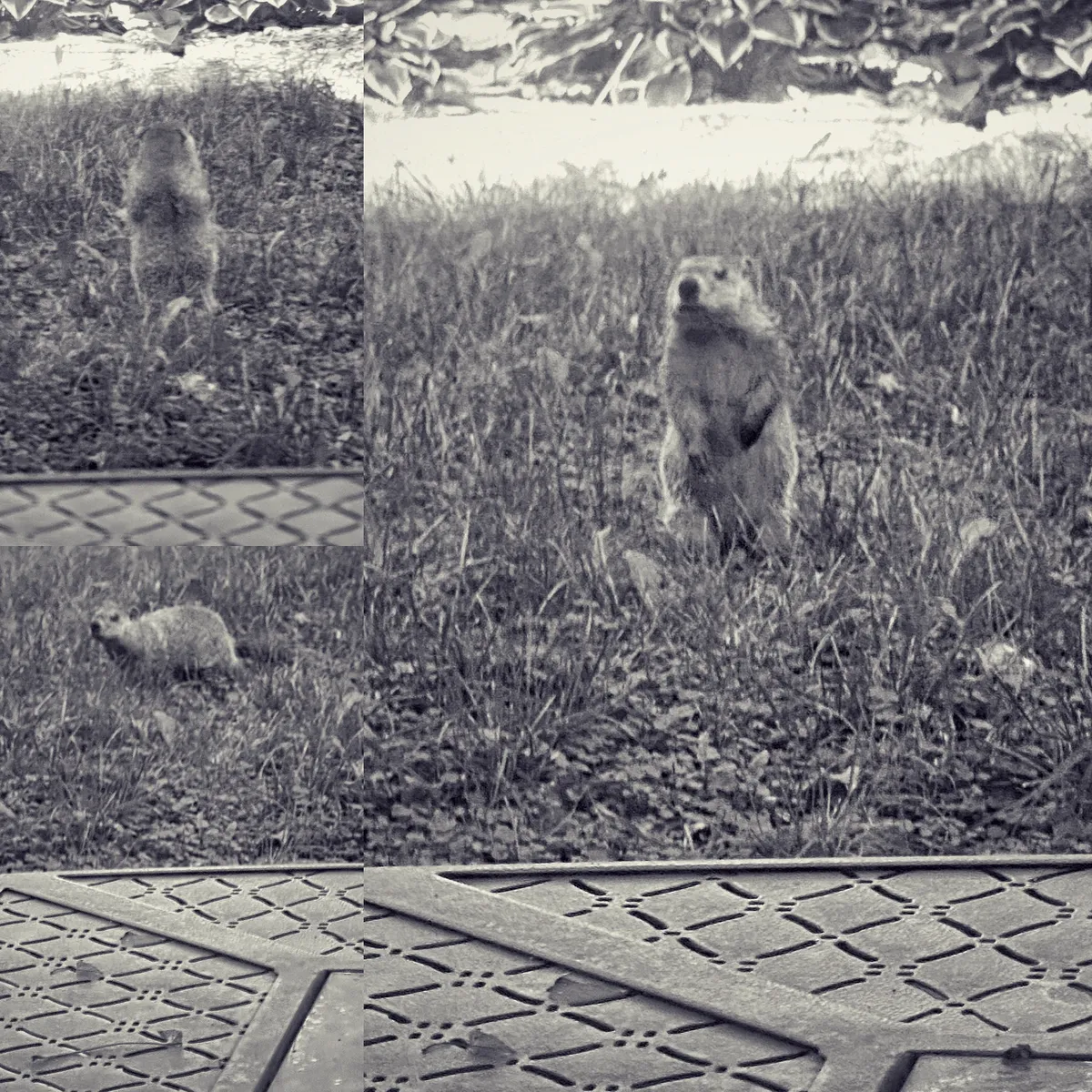
Emerging from the cold season and getting ready to rumble
Emerging from the cold season
Let us take a moment — while the ice storm does what ice storms do to Madison in March, which is to say everything — to look at a thing I've been quietly building through the cold season instead of guffawing at what Morality has become. Progress takes many forms.
(He has whiskey. He has a cat. He is fine.)
Working land
I have written before about the land — as an exercise in humility and inner calm, as a way to process something difficult from an oblique angle, as an excuse to photograph bees. What I have not written about is the machinery of it. We are systems-oriented people who desire systems-oriented tools to manage our world, and we have as yet failed to produce a Thing What Provides Vision of what we Have, what we Must Do, and what we Want.
Until, maybe, now.
Measurements as a point of origin
Understand the following:
- We got extremely lucky when we moved here — this was before the 2018 market implosion that has since made this specific square mileage of Madison something between aspirational and surreal.1
- It is 1.25 acres, still in town, technically closer to work than the last place.
- It was five years neglected when we arrived. It has been a lot of work for two disabled people to restore.
- It came with 4 cherries, 2 fifty-foot grape vines, 2 pears (one dwarf, one pretending to be dwarf), 2 plums, 6 apples, a 75-square-foot garden, a blackberry bramble the size of two semi trucks, 2 raspberry brambles along half the garden's exterior, two elderberry patches, 3 mulberry trees, and any number of perennial herbs, medicinals, and edible greenery of unclear provenance growing in corners we had not yet unearthed.
We did not know what we were getting into. Immensity. Audacity. Insanity.
30-odd fruit plantings, 4 cats, and 2 disabled people try to manage an orchard
If I had to name the year we got it back into shape, it would be 2025 — seven years in, give or take. We understand now how to care for the land and the trees and the insects and the system in a way that respects what was here before us. After all, it will persist long after we are gone, and we want whoever stewards it next to inherit something healthy. Something still alive.
Also we want Gordon2 the groundhog and his progeny to thrive. We are negotiating.3
The physicality has become mostly second nature — the sound of sharpened shears through dead wood is a kind of music now, sharp and final, the way good sentences end. But there is still a great deal to keep in mind. Spreadsheets on spreadsheets. Journals. Diagrams. Notes from seven years ago that reference locations that no longer exist by the names we gave them.
Nothing that could give us a bird's-eye view down to a specific garden bed. That is what I have been trying to solve.
It always starts in a spreadsheet
My wife has maintained an orchard spreadsheet for years — meticulous, color-coded, the kind of document that accretes detail the way old houses accrete additions: functional, slightly haunted, impossible to fully understand from the outside.
The problem with a spreadsheet is that it doesn't know where it lives.
It tracks the what with frightening precision — species, variety, planted year, cost per unit, the specific year of death for every plant that didn't survive its first Wisconsin winter. A ledger of the living and the fallen. But ask it where the NW Orchard sits relative to the chicken run, and it stares back at you, blinking its empty cells like an entity that has never once looked out a window.
(The Nettle Bed appears in three separate location fields because the original planting happened across three separate years by someone optimistic about naming conventions and the containment of seeds. [It was us. {Definitely her.}] We were optimistic.)
Obsidian, my beloved
I have been an Obsidian fanatic for a while now — in part because it is a tool for building strange and useful things atop a vault of plain text files, and I find the plainness of it reassuring in the way that exposed structural beams are reassuring. You can see what is holding it up.
Obsidian Bases fixed the what.
Each plant became its own note — a small, tagged record carrying location, zone, harvest window, prune timing, the name of the nursery, the year we gave up on it. Bases reads those tags and assembles them into tables on demand. Filtered. Sorted. Answering questions you didn't know you needed to ask until the moment you were standing in the orchard in March wondering which unlabeled stick was the medlar.
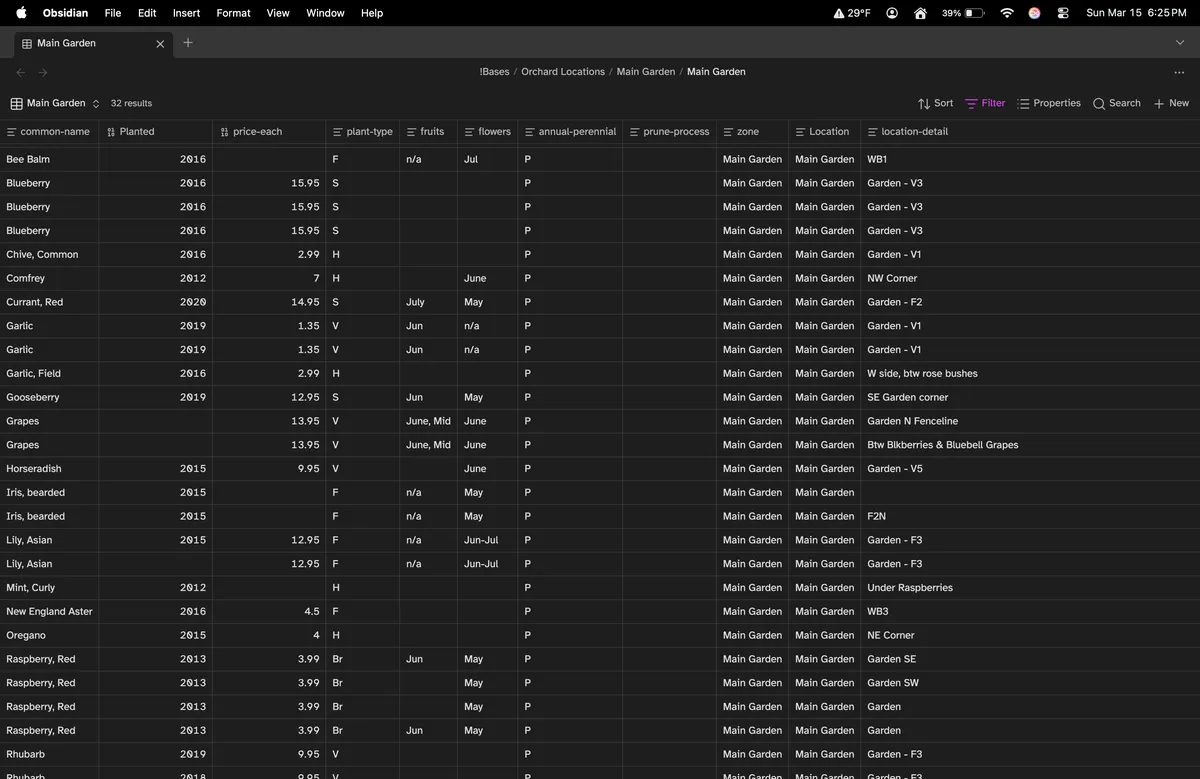
Canvas fixed the where.
The top-level canvas is a map — zones arranged roughly as they exist on the actual land, north up, house in the middle, the wildflower bed slightly apart from everything, doing its own thing. Click into any zone and you drop into an area canvas, sub-location cards arrayed in a grid, each one a live window into the Base below. It is not a drawing of the orchard. It is a database that has developed, improbably, a sense of direction.
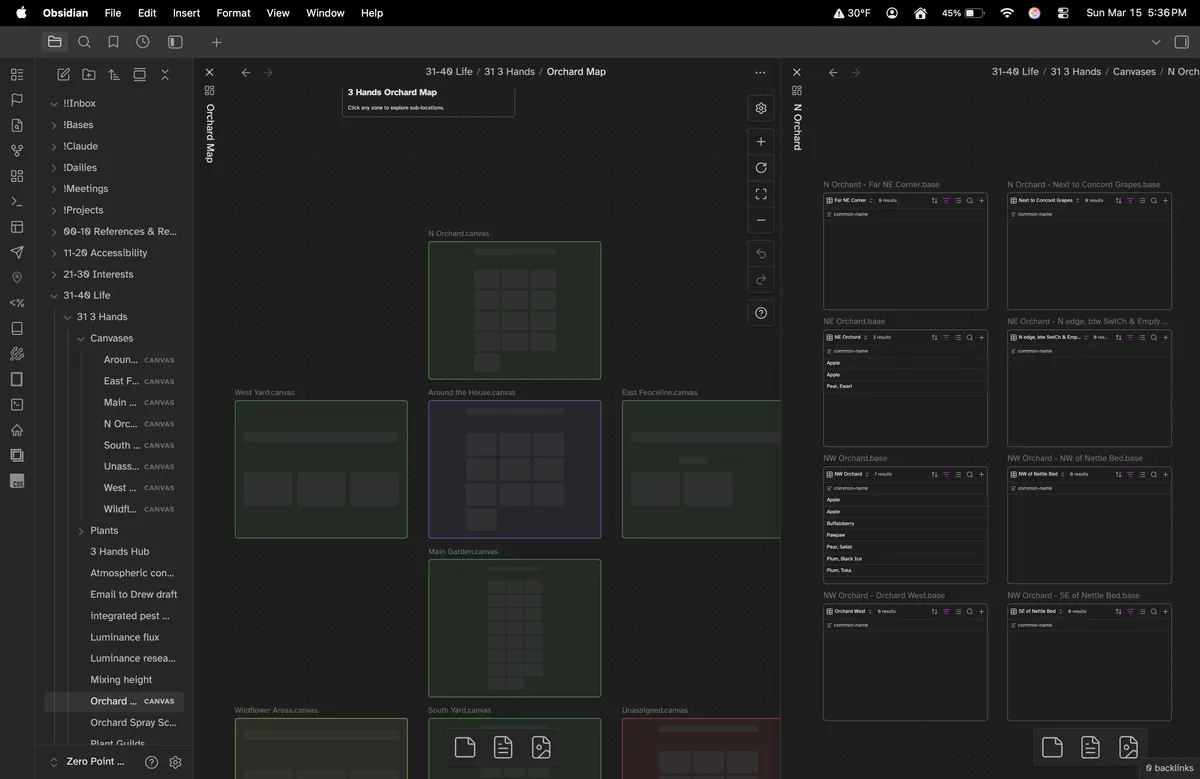
And from there, deeper — into specific beds, specific corners.
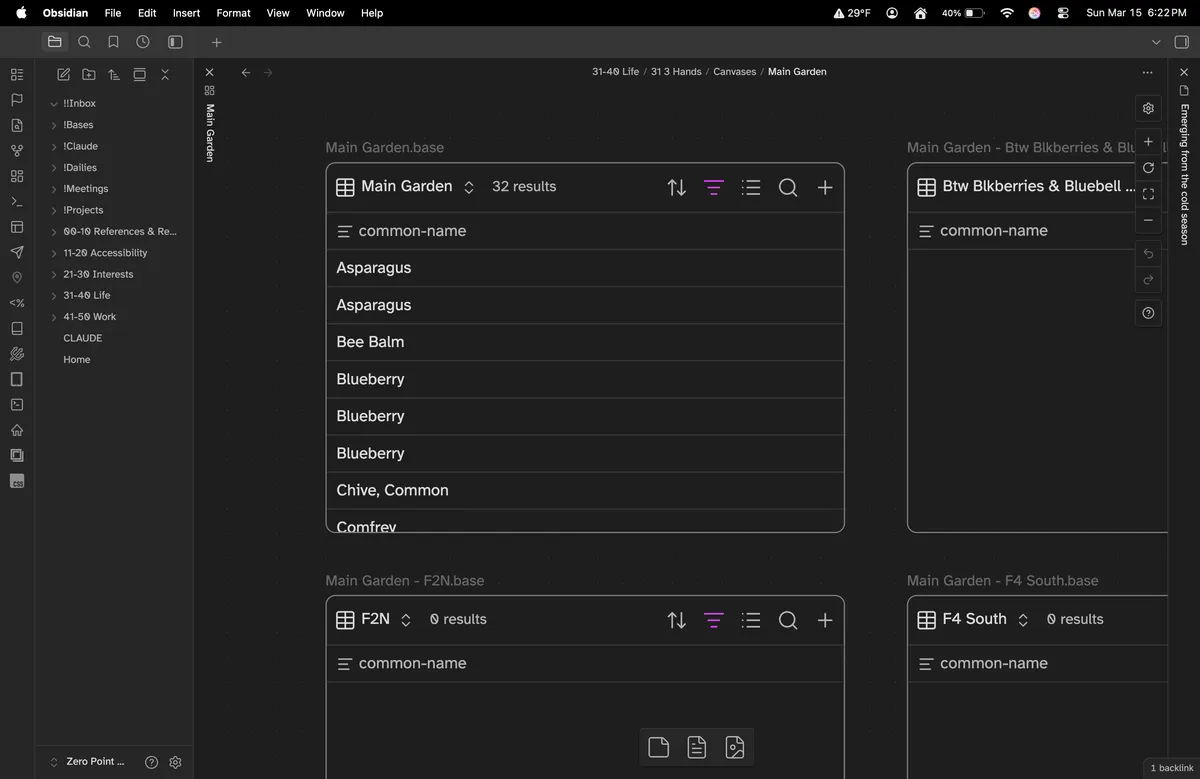
Still just text files under the hood. All the way down.
Bringing things together
The two tools do different things. Canvas gives you space. Bases gives you truth. Neither is useful without the other, and neither is useful without the notes underneath — without the seven years of tagging and pruning and recording and losing things that fed the system in the first place.
Which is, I suppose, not unlike the orchard itself.
You don't build a food forest in a season. You plant things in the wrong place, and you move them. You lose a tart cherry to a hard winter and a buffaloberry to bad drainage and you write it down — the Red Shirts, my wife calls them — because the record of failure is part of how you learn to do it right. You layer. You compound. Each year's knowledge sits underneath the next one the way roots sit underneath soil. Eventually, without quite noticing it happening, you have something that works.
The tools built the same way. Notes first. Then structure. Then a map that knows where it is.
None of which means we have figured it out. We are still two disabled people managing more land than was probably wise. Gordon is still a menace. The medlar is still unlabeled. Or dead. (Probably dead) But for the first time in seven years, I can open a canvas, click into the north orchard, and find out exactly what is planted next to the concord grapes without having to walk outside in an ice storm to check.
This is, I am prepared to argue, progress.